
Thailand has established itself as one of Southeast Asia's most dynamic export economies, with a diversified portfolio of products reaching markets across every continent. Understanding what constitutes a major export of Thailand provides crucial insights for international buyers, importers, and distributors seeking reliable sourcing partnerships. The country's export strengths span manufacturing, agriculture, and value-added processing, creating opportunities for B2B buyers across multiple sectors.
Thailand's Export Economy in 2026
Thailand's export sector continues to demonstrate resilience and adaptability in the global marketplace. According to Bank of Thailand data, the nation's export economy represents a significant portion of GDP, with total merchandise exports exceeding $280 billion annually. This robust performance reflects decades of strategic industrial development and trade partnerships.
The diversity of Thailand's export portfolio distinguishes it from many regional competitors. Rather than relying on a single commodity or sector, Thailand has cultivated expertise across manufacturing, agriculture, and processed goods. This diversification provides stability and creates multiple entry points for international buyers seeking sourcing partners.
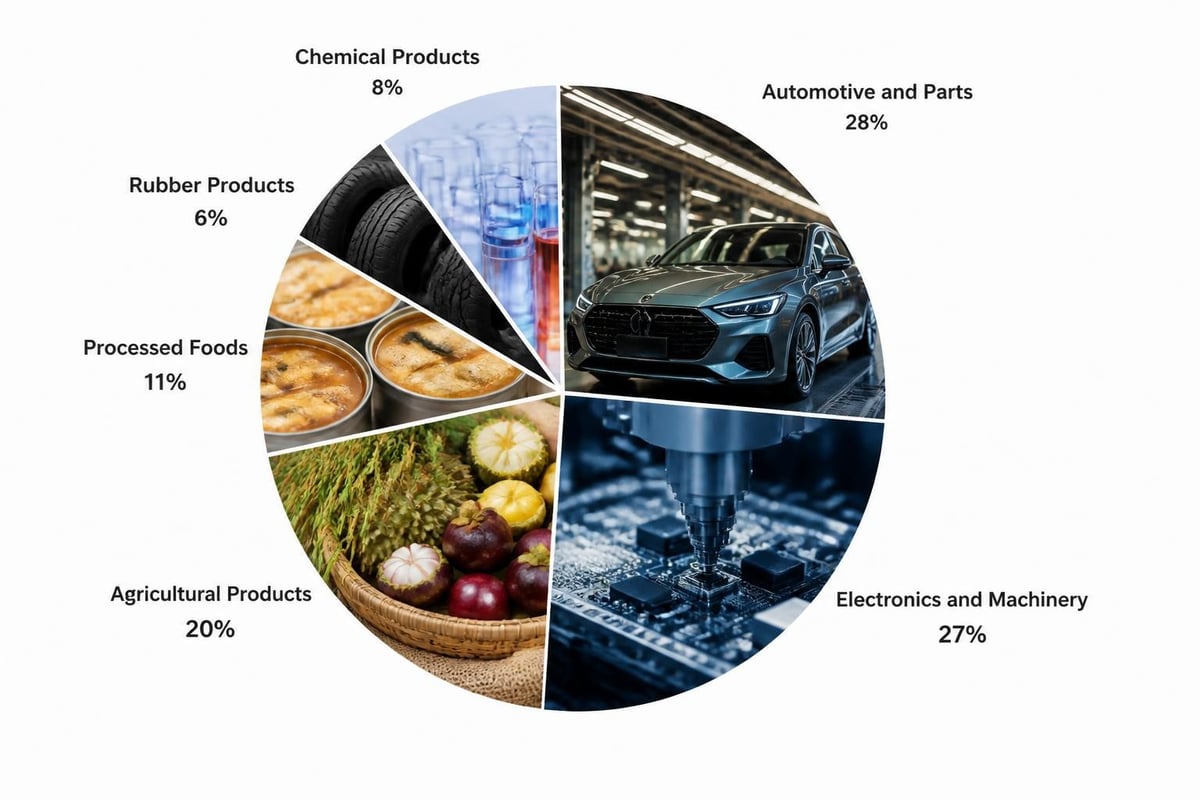
Key Export Performance Indicators
Several metrics highlight Thailand's position as a major exporter:
- Trade volume: Consistently ranking among the top 25 global exporters
- Market reach: Products shipped to over 190 countries worldwide
- Growth sectors: Electronics, automotive, and processed foods showing sustained expansion
- Quality reputation: ISO certifications and international standards compliance across industries
The World Bank tracks Thailand's export performance, noting that goods and services exports account for approximately 60-65% of GDP, underscoring the economy's export-oriented structure.
Automotive and Transportation Equipment
The automotive sector represents a major export of Thailand, with the country earning recognition as the "Detroit of Asia." Thailand's automotive industry encompasses complete vehicles, engines, auto parts, and components, serving both original equipment manufacturers (OEMs) and aftermarket suppliers globally.
| Product Category | Primary Markets | Export Value (USD Billions) |
|---|---|---|
| Passenger vehicles | Australia, Indonesia, Philippines | $18-22 |
| Automotive parts | USA, Japan, EU | $15-18 |
| Commercial trucks | Middle East, Africa | $8-12 |
| Motorcycles | ASEAN, Latin America | $3-5 |
Thailand's automotive exports benefit from established manufacturing ecosystems in the Eastern Economic Corridor (EEC), where Thailand Board of Investment incentives have attracted major global brands. The integration of supply chains, skilled workforce, and quality control systems makes Thai automotive products competitive internationally.
For B2B buyers, the automotive sector offers opportunities beyond vehicles themselves. Component manufacturers, tier-2 and tier-3 suppliers, and specialized parts producers actively seek distribution partnerships in emerging markets.
Electronics and Electrical Machinery
Electronics and electrical equipment constitute another major export of Thailand, with production ranging from integrated circuits to complete computer systems. The sector's sophistication has evolved significantly, moving from basic assembly to design and engineering capabilities.
Electronics Export Categories
Thailand's electronics exports encompass several specialized segments:
- Hard disk drives: Thailand produces approximately 40% of global HDD output
- Integrated circuits and semiconductors: Growing production capacity
- Air conditioning units: Both residential and commercial systems
- Printed circuit boards: Supporting multiple electronics applications
- LED products: Lighting solutions and display components
The ITC Trade Map database provides detailed breakdowns of Thailand's electronics exports by HS code, enabling buyers to identify specific product categories and suppliers. International distributors often source electronics components from Thailand due to competitive pricing and reliable quality standards.
Natural Rubber and Rubber Products
As one of the world's largest rubber producers, Thailand's rubber industry represents a historically significant major export of thailand. The sector encompasses raw natural rubber, processed rubber, and finished rubber products including tires, gloves, and industrial components.
Thailand's rubber production benefits from ideal growing conditions, established plantations, and processing expertise. Export-grade rubber meets international specifications for various applications:
- Automotive tires: Raw material and finished products
- Medical gloves: Latex examination and surgical gloves
- Industrial rubber: Seals, gaskets, hoses, and belts
- Rubber wood: Furniture and construction materials
- Specialized products: Technical rubber for aerospace and medical devices
The rubber sector demonstrates Thailand's ability to capture value at multiple points in the supply chain, from plantation to finished goods, creating sourcing opportunities for buyers at different processing levels.
Agricultural Products and Food Exports
Agricultural commodities and processed food products form a substantial portion of Thailand's export portfolio. The country's tropical climate, agricultural expertise, and food processing capabilities make it a preferred supplier for international food importers and wholesale distributors.
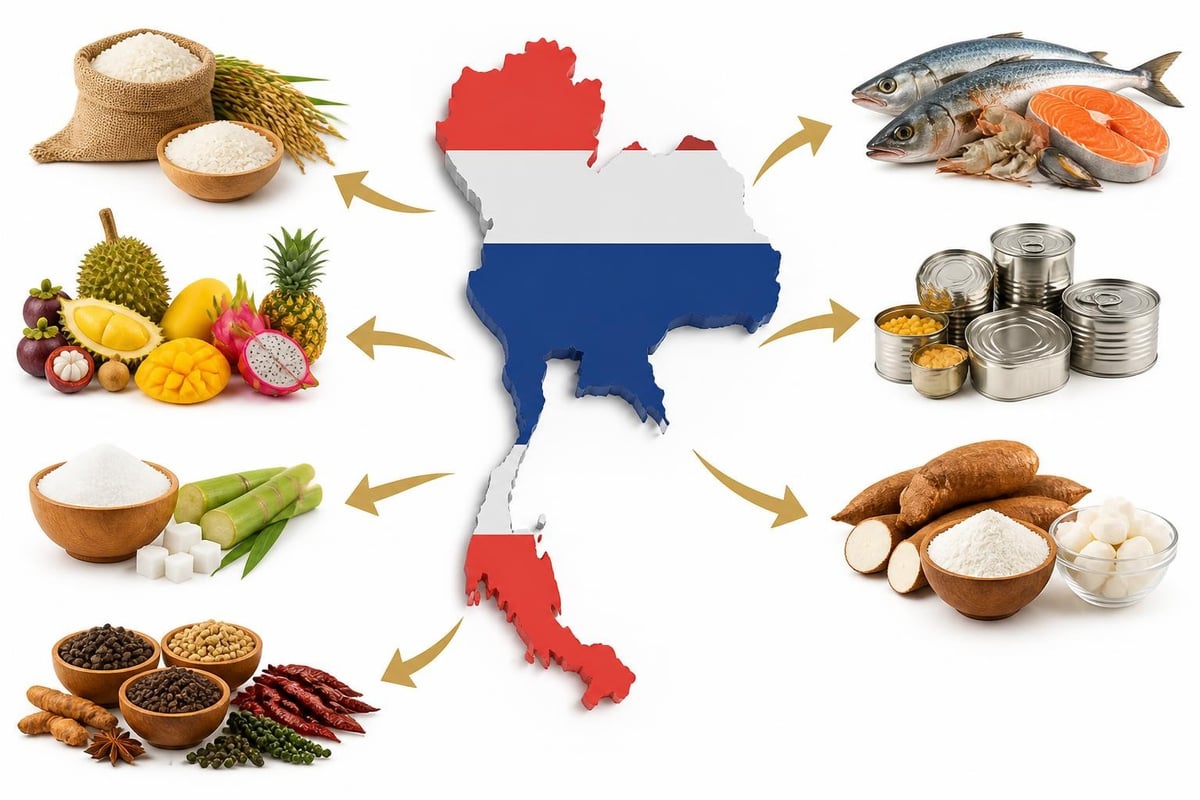
Major Agricultural Exports
| Product | Global Ranking | Key Export Markets |
|---|---|---|
| Rice | Top 3 exporter | Africa, Middle East, Asia |
| Cassava products | #1 exporter | China, Indonesia, Japan |
| Natural rubber | Top 2 exporter | China, USA, Japan |
| Sugar | Top 5 exporter | Indonesia, Cambodia, Myanmar |
| Chicken products | Top 5 exporter | Japan, EU, Middle East |
Thailand's food processing industry adds significant value to agricultural exports. International buyers source canned tuna, pineapple products, coconut-based ingredients, and ready-to-eat meals from Thai manufacturers. The Asian Development Bank reports ongoing investment in food safety standards and processing technology, enhancing Thailand's competitiveness in premium food markets.
Seafood and Fishery Products
The seafood sector represents a particularly important major export of Thailand, with the country ranking among the world's top exporters of processed fish and seafood products. Thailand's fishing industry, aquaculture operations, and processing facilities serve global markets with diverse products.
Key seafood exports include:
- Frozen and canned tuna
- Shrimp and prawns (farmed and wild-caught)
- Cephalopods (squid, cuttlefish, octopus)
- Surimi and fish-based products
- Processed seafood (fish balls, crab sticks)
The FAO State of World Fisheries report highlights Thailand's role in global seafood trade and ongoing sustainability improvements. International importers value Thai seafood for processing quality, product consistency, and competitive pricing.
For wholesale buyers and distributors, Thailand's seafood industry offers established supply chains with certifications meeting EU, US, and Japanese market requirements. Traceability systems and sustainable sourcing practices increasingly characterize the sector.
Chemical and Petrochemical Products
Thailand's chemical industry contributes significantly to export revenues, producing both basic chemicals and specialized compounds. The petrochemical sector benefits from the country's refinery capacity and proximity to Southeast Asian markets.
Chemical Export Categories
The chemical sector encompasses diverse product groups:
- Refined petroleum products: Diesel, gasoline, jet fuel
- Plastics and resins: Polyethylene, polypropylene, PVC
- Specialty chemicals: Industrial additives, surfactants
- Fertilizers: NPK compounds, urea
- Cosmetic ingredients: Natural extracts, essential oils
Thailand's chemical exports serve both regional and international markets, with ASEAN countries representing major destinations alongside China, India, and Australia. B2B buyers appreciate Thailand's chemical industry for technical support, flexible order quantities, and logistics efficiency.
Thai Food Ingredients and Wellness Products
Among Thailand's diverse exports, Thai food ingredients and wellness products have gained significant international traction. This category represents a major export of Thailand that appeals to health-conscious consumers and specialty food distributors worldwide.
International buyers increasingly source Thai food ingredients, wellness products, and herbal formulations directly from Thai suppliers and exporters. These products leverage Thailand's botanical diversity and traditional medicine heritage:
- Coconut products: Virgin coconut oil, coconut milk powder, desiccated coconut
- Herbal ingredients: Turmeric, galangal, lemongrass, kaffir lime
- Functional beverages: Butterfly pea tea, Thai herbal teas, wellness drinks
- Traditional medicine: Herbal balms, aromatic oils, massage products
- Natural personal care: Spa-quality products with Thai botanicals
Exporters specializing in these categories provide international distributors with products that combine traditional Thai knowledge with modern processing standards. Quality control, organic certifications, and export documentation support smooth transactions for wholesale buyers.
Machinery and Equipment
Thailand's machinery sector has evolved into a significant major export of Thailand, producing equipment for construction, agriculture, and manufacturing. The industry serves both developed and developing markets with competitively priced machinery.
Export machinery categories include:
- Agricultural machinery and implements
- Construction equipment and parts
- Machine tools and metalworking equipment
- Industrial robots and automation systems
- Packaging and processing machinery
Thailand's machinery exports benefit from engineering capabilities developed through decades of technology transfer and local innovation. International buyers find Thai machinery offers favorable price-performance ratios compared to European or Japanese equivalents while maintaining acceptable quality standards.
Textiles and Garments
The textile and apparel sector maintains its position as a major export of Thailand despite regional competition. Thailand's textile industry emphasizes quality fabrics, technical textiles, and fashion garments rather than competing solely on price.
| Textile Category | Strengths | Target Markets |
|---|---|---|
| Fashion garments | Design, quick response | EU, USA, Japan |
| Sportswear | Performance fabrics | Global brands |
| Home textiles | Cotton products | USA, Australia |
| Technical textiles | Industrial applications | Manufacturing sectors |
| Silk products | Premium materials | Luxury markets |
Thailand's garment manufacturers increasingly focus on sustainable production, organic materials, and ethical labor practices. These factors attract international brands seeking responsible sourcing partners in Asia.
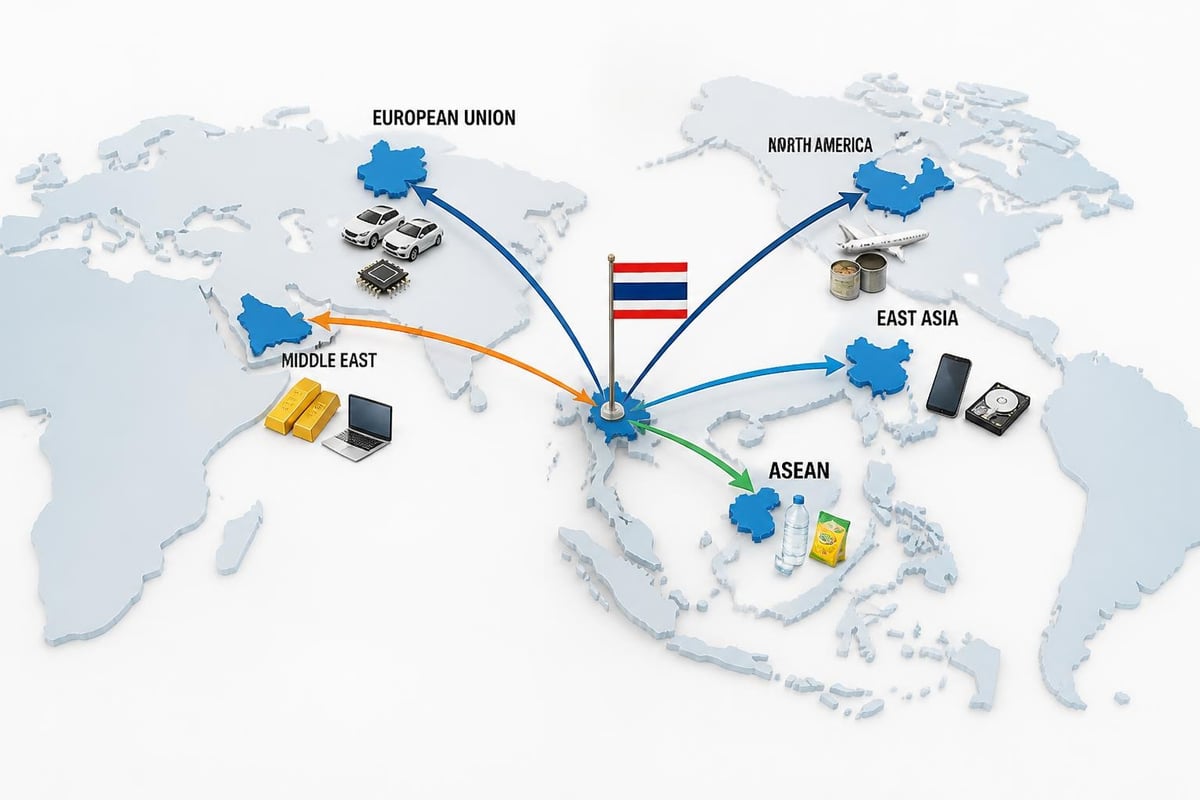
Gems and Jewelry
Thailand's gems and jewelry sector represents a specialized but valuable major export of Thailand. Bangkok serves as a regional hub for gem cutting, jewelry manufacturing, and precious metal trading.
Jewelry Export Strengths
Thailand's jewelry industry offers several competitive advantages:
- Skilled craftsmanship: Generations of gem-cutting and jewelry-making expertise
- Material sourcing: Access to regional gemstone supplies
- Design capabilities: Both traditional and contemporary styles
- Manufacturing scale: From custom pieces to mass production
- Quality certification: GIA-trained gemologists and international standards
International jewelry retailers, wholesalers, and designers source from Thai manufacturers for product quality, design flexibility, and competitive pricing. The sector particularly excels in silver jewelry, gemstone jewelry, and custom production runs.
Furniture and Wood Products
Furniture manufacturing constitutes another important major export of Thailand, with products ranging from mass-market items to custom high-end pieces. Thai furniture exports utilize both plantation timber and sustainable materials.
Key furniture export categories:
- Wooden furniture (teak, rubber wood, mango wood)
- Rattan and bamboo furniture
- Office furniture systems
- Outdoor and garden furniture
- Contract furniture for hospitality
Thailand's furniture industry serves international buyers through established showrooms, design capabilities, and flexible manufacturing. Container shipment efficiency and competitive pricing make Thai furniture attractive to importers in North America, Europe, and Australia.
Export Quality and Standards Compliance
Understanding the quality frameworks supporting Thailand's major exports helps international buyers evaluate sourcing opportunities. Thai exporters increasingly adopt international standards and certifications to meet global market requirements.
Common certifications and standards:
- ISO 9001 (Quality Management)
- ISO 22000 (Food Safety Management)
- HACCP (Food safety protocols)
- GMP (Good Manufacturing Practice)
- Organic certifications (USDA, EU Organic)
- Halal certification
- Fair Trade certification
The UK Government Thailand trade factsheet summarizes export categories and provides reference data for buyers conducting market research. Quality assurance systems vary by industry, but leading Thai exporters maintain documentation and traceability meeting international requirements.
Sourcing from Thai Exporters
International buyers seeking to source a major export of Thailand should understand typical procurement processes and supplier relationships. Thai exporters generally accommodate various buyer requirements, from small test orders to container-load quantities.
Buyer Considerations
When evaluating Thai suppliers, consider these factors:
- Minimum order quantities: Vary by product and manufacturer
- Payment terms: Often negotiable based on relationship and order volume
- Lead times: Typically 30-90 days depending on product complexity
- Shipping logistics: FOB, CIF, and DDP options available
- Quality inspection: Third-party inspection services accessible
- Documentation: Export licenses, certificates of origin, phytosanitary certificates
Working with established Thai exporters or sourcing agents can streamline the procurement process, particularly for buyers new to the Thai market. Many suppliers maintain English-speaking sales teams familiar with international trade procedures.
Trade Data and Market Intelligence
Accessing reliable trade data helps buyers identify which products represent the highest-value major export of Thailand categories and track market trends. Several authoritative sources provide Thailand export statistics.
The UN Comtrade database offers downloadable trade data by HS code, enabling detailed analysis of specific product categories, destination markets, and value trends. This granular data supports informed sourcing decisions and market entry planning.
Key data points to monitor:
- Export value trends by product category
- Primary destination markets for specific products
- Year-over-year growth rates
- Seasonal patterns in agricultural exports
- Emerging product categories
Market intelligence combined with direct supplier engagement provides the foundation for successful sourcing relationships with Thai exporters across all major product categories.
Regional Export Variations
Thailand's export strengths vary regionally, with certain provinces specializing in specific industries. Understanding these geographic concentrations helps buyers identify optimal sourcing locations.
Major export production regions:
- Eastern Seaboard: Automotive, petrochemicals, electronics
- Central Plains: Rice, processed foods, textiles
- Northern Region: Agricultural products, handicrafts, coffee
- Southern Region: Rubber, seafood, palm oil, coconut products
- Northeast Region: Silk, cassava, rice, textiles
Regional specialization reflects natural resource availability, infrastructure development, and historical industry clustering. International buyers benefit from this concentration through established supply chains and industry expertise in specific areas.
Future Export Trends
Thailand's export landscape continues evolving in response to global market demands and technological advancement. Several trends are shaping the future composition of major exports.
Emerging export opportunities:
- Electric vehicle components and EV manufacturing
- Bio-based chemicals and sustainable materials
- Smart agriculture technology and precision farming equipment
- Medical devices and healthcare products
- Digital services and software solutions
- Sustainable packaging materials
- Plant-based food ingredients
These developing sectors complement established major exports, offering international buyers additional sourcing opportunities. Thailand's government actively supports export diversification through the Board of Investment and trade promotion agencies, creating favorable conditions for new export industries.
Thailand's diverse export portfolio, spanning automotive components to agricultural products, offers international buyers extensive sourcing opportunities across multiple sectors. Each major export of Thailand reflects decades of industry development, quality improvement, and global market integration. For wholesale importers, distributors, and retailers seeking reliable Thai suppliers and authentic products, BUARADA provides comprehensive export solutions, product sourcing services, and quality assurance for Thai food ingredients, wellness products, coconut oil, herbal formulations, and personal care items. Contact us to discuss your wholesale requirements and explore how we can support your sourcing needs with genuine Thai products backed by export expertise and international shipping capabilities.